
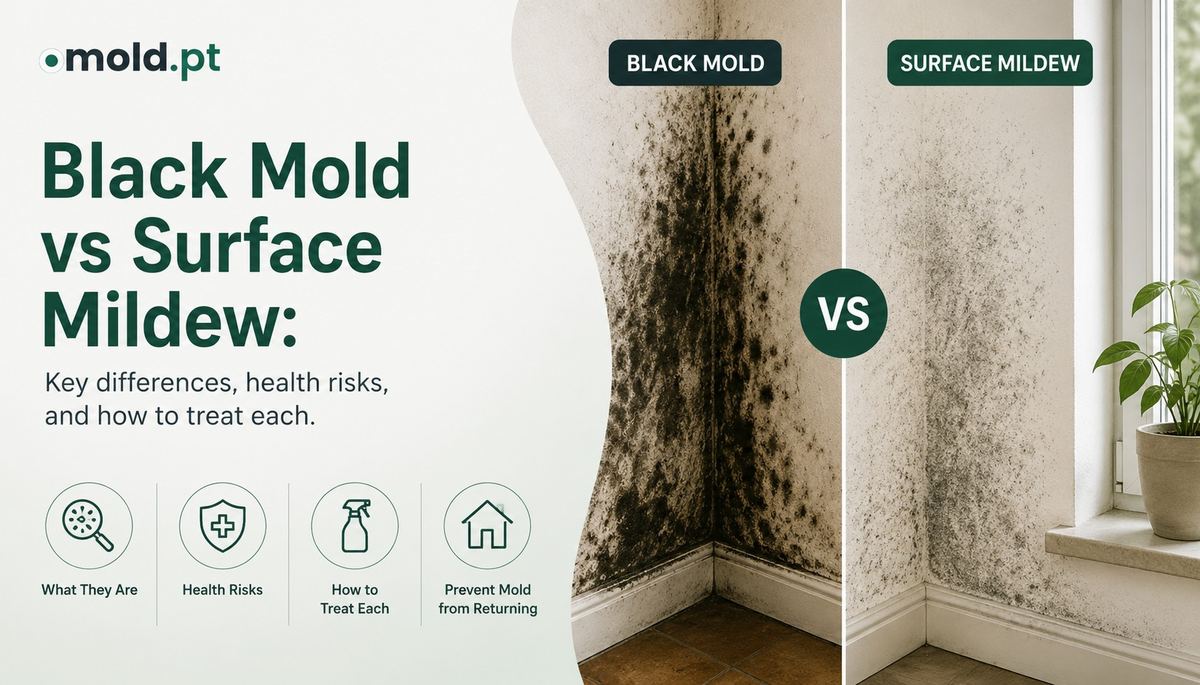
What's the Difference Between Surface Mildew and Active Mold? #
The distinction matters because the fix is completely different. Mildew on bathroom tile grout is a cleaning problem. Mold inside drywall, wood trim, or behind a shower surround is a moisture-source problem, and cleaning the visible patch does nothing to address what's feeding it.
Three things separate them in practice:
Surface type
Mildew grows on hard, non-porous surfaces: shower tile, window frames, glossy bathroom ceilings. Mold prefers porous materials: drywall paper, wood, grout lines, fabric, MDF against exterior walls.
Texture
Mildew is flat and powdery, gray or white, sometimes yellow-tinged. Mold is fuzzy, slimy, or raised, in colors from black and dark green to pink or orange.
After cleaning
Mildew wiped with diluted bleach (1:10) shouldn't return for a week. Active mold on a porous surface typically resurfaces within 48-72 hours.
Black mold or surface mildew? Do not guess.
On-site species testing and moisture mapping show what is growing and what is feeding it. Both are included in the €695 inspection.
The Three Tests You Can Run Before Calling Anyone #
The bleach-wipe test
Apply diluted bleach (1:10 ratio) to a small section, let it sit 5 minutes, wipe clean. Photograph the spot. Check again in 3-4 days. No regrowth points to mildew. Any regrowth points to active mold with a moisture source still present.
The smell test
Get within 30cm of the affected area after ventilating the room for at least an hour. A musty smell that persists after cleaning and airing indicates mold is present in the material, even if no longer visible.
The humidity reading
A basic hygrometer (under €15) placed in the room for 24 hours gives baseline relative humidity. A reading consistently above 65% points toward condensation (humidade de condensação) as the underlying cause.
None of these three tests require professional equipment, and running all three takes under 30 minutes. What they can't tell you is where excess moisture is coming from if the humidity reading is high, which is the point at which a proper diagnostic inspection becomes worth the cost.
When Surface Mildew Is Actually a Symptom of Something Bigger #
The recurrence pattern is the tell. If the same spot needs the same bleach treatment every 6-8 weeks, the surface growth is a symptom of a structural or ventilation gap, not an isolated hygiene issue. Ground-floor apartments in coastal municipalities like Cascais and Sintra see this pattern more often, because thermal bridging (ponte térmica) at exterior walls combined with limited cross-ventilation keeps surface temperatures low enough for condensation to form even when the room feels dry.
What Happens If You Guess Wrong #
The reverse mistake also happens: treating ordinary bathroom mildew as if it requires full remediation, paying for a diagnostic inspection and species testing on a problem a €15 hygrometer and a bleach-wipe test would have resolved for free.
New mechanical extraction unit for chronic condensation mildew.
Structural remediation once moisture works into drywall or timber framing.
How mold.pt Confirms the Cause #
Inspect
Test
Remediate
Verify
A diagnostic inspection covers what at-home tests can't: a moisture meter reading at multiple points, thermal imaging where relevant to check hidden moisture behind flooring or wall cavities, and a written cause report distinguishing condensation, rising damp (humidade ascensional), penetrating damp, or a plumbing leak. Post-remediation clearance testing, where remediation is needed, confirms the fix worked.
Not sure what's causing the damp?
mold.pt diagnoses the actual cause with moisture mapping before any remediation starts. Inspect. Test. Remediate. Verify.
Frequently Asked Questions #
Q Can black mold and mildew grow in the same spot at the same time?
Q Is black-colored growth always more dangerous than green or white growth?
Q Does painting over mildew or mold stop it from coming back?
Q How long does a diagnostic inspection take?
Q Is a hygrometer reading alone enough to confirm mold risk?
Conclusion #
A bleach-wipe test, a smell check after ventilating, and a 24-hour hygrometer reading answer the first question: cleaning job or diagnostic job. What they can't answer is where the moisture is coming from when the answer points to something ongoing rather than a one-off spill.
Recurring damp or growth that keeps coming back?
mold.pt diagnoses the actual cause with moisture mapping before any remediation starts. No surprises.