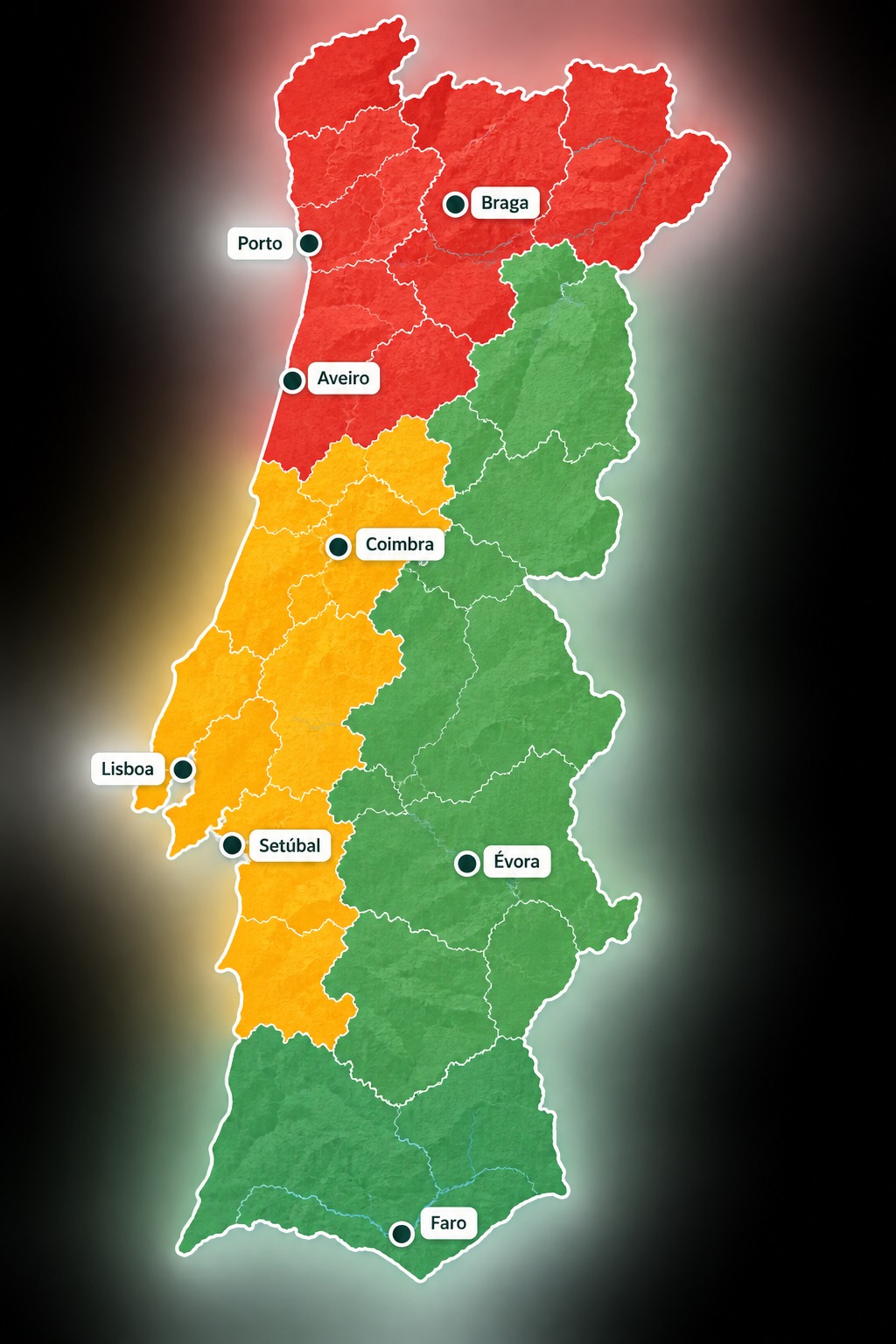
Winter humidity varies dramatically across the country. Coastal and northern regions face the highest sustained humidity levels, creating ideal conditions for mold growth.
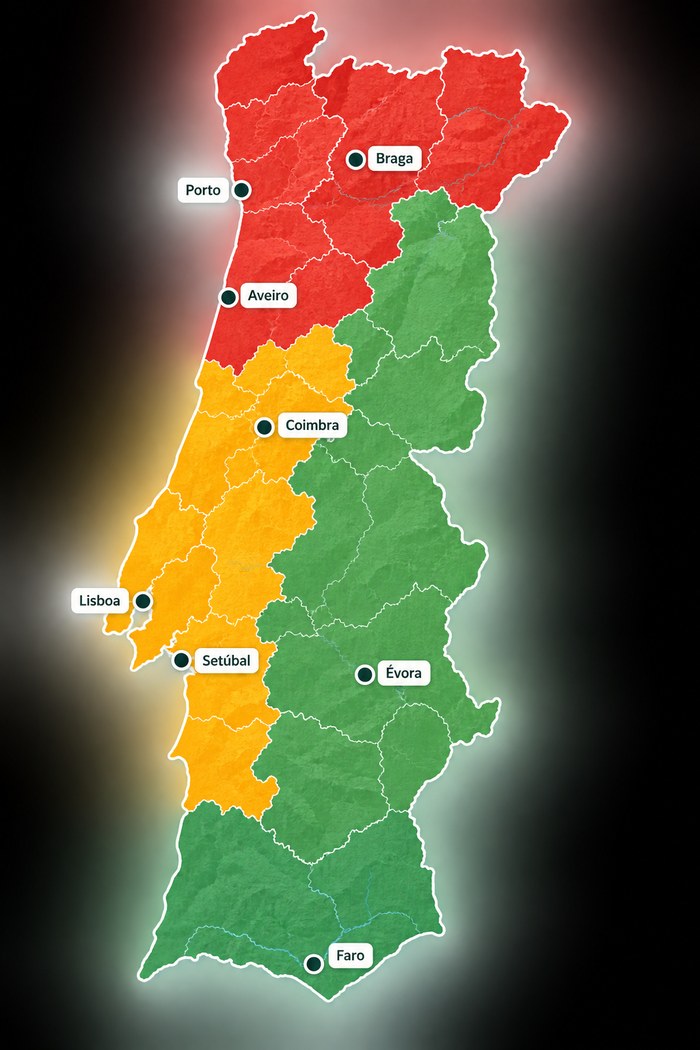
Explore the zones below for details on each region.
Every card below links back to the map above. Hover or click either one and the other updates.
Porto's winter humidity averages near 77%, the highest sustained reading on the mainland.
Moderate humidity with coastal influence. Mold risk increases in older buildings with poor ventilation.
Lower coastal influence and generally lower winter humidity reduces mold formation risk.
Important: Building age, ventilation, insulation, and maintenance matter more than region alone. Use this map as a guide, not a guarantee.
How this map is built: the three zones come from IPMA regional climate normals for rainfall and relative humidity, checked against typical building age and ventilation provision under the RGEU. It's not a tally of confirmed mold cases, and any single property's real risk still depends on its own construction and moisture history. A diagnostic inspection is the only way to confirm that.
One of the highest sustained relative humidity readings on the mainland, per IPMA climate normals.
The typical gap in relative humidity between the Alentejo interior and Portugal's coastline.
Once the cause is confirmed, cost depends on affected area and whether it's condensation, rising damp, or penetrating damp.
IPMA climate normals put Porto's average winter relative humidity near 77%, well above the interior. Sustained humidity above roughly 65% for more than 48 hours is enough on its own to create conditions for mold growth.
Most apartments built before 1990 have no mechanical extraction. The RGEU (Decreto-Lei n.º 38 382, 1951) has been amended over nearly eight decades and still hasn't fully closed that gap.
Sitting near the Atlantic or the Tagus estuary raises ambient humidity on its own. In Lisboa and Setúbal it adds estuary-driven condensation on top of thermal bridging (ponte térmica) from sea exposure.
Algarve properties left closed for weeks between visits lose the ventilation cycle that would otherwise keep humidity in check. That's what pulls the region into moderate risk despite a drier climate than the north.
No. The three zones come from IPMA rainfall and humidity data plus typical building age and ventilation, not a count of confirmed mold cases. Your own property's risk depends on its specific construction and ventilation history.
Rainfall runs lower here than anywhere else on the coast. What keeps it out of the low tier is occupancy: properties sealed shut for weeks between visits lose the airflow that would otherwise clear the humidity.
No. Region sets a baseline. Ventilation habits, construction era, and a specific defect like a missing damp-proof course or a roof leak matter more for any single property. A diagnostic inspection is the only way to confirm cause.
Tiers come from IPMA regional climate normals for rainfall and relative humidity, checked against typical building age and ventilation standards under the RGEU. We review it periodically as new climate data comes in, and the date above the map shows the last check.
Region is a starting point, not a diagnosis. Get your property checked with moisture mapping and testing.
Request an Inspection