
Diagnosis & Testing Cluster Article

Mold vs. Dirt or Old Stains: How to Tell the Difference

By Pascal NiggliPublished July 16, 20265 min read
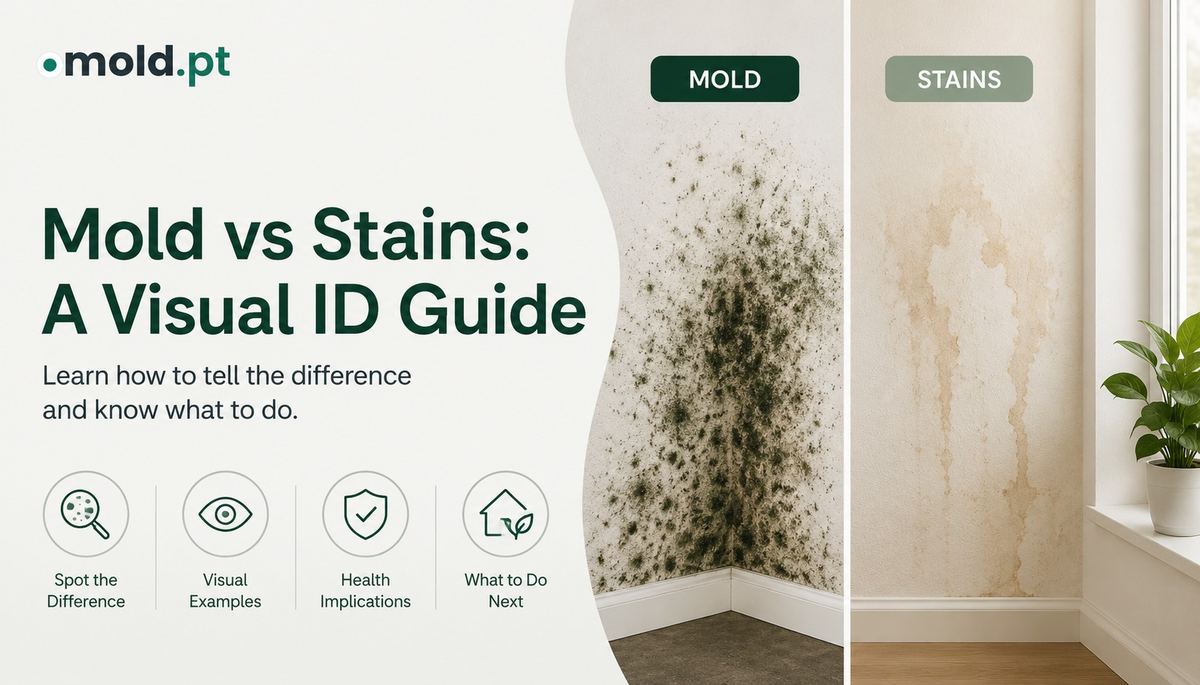
Mold vs stains visual ID guide, side by side comparison of mold and a water stain on a wall
Quick Answer Mold is usually fuzzy, raised, or spreading with a musty smell, while efflorescence (salitre) is a flat white/grey crust, and old water stains are dry, static, and don't change week to week. A moisture meter reading above 60% relative humidity at the surface is the most reliable sign that a mark is active mold rather than a cosmetic stain.
60% RHActive mold threshold
5–7 daysLab species result turnaround
60–90 minOn-site diagnostic visit
Lab-Verifiedmold.pt species testing
What's in this guide
In this article
  1. Why This Is the First Question Almost Everyone Asks
  2. What Does Mold Actually Look Like?
  3. What Is Efflorescence (Salitre) and Why Is It Confused With Mold?
  4. How Do Old Water Stains and Dirt Differ From Active Mold?
  5. How mold.pt Confirms the Difference
  6. Frequently Asked Questions
  7. Conclusion

Why This Is the First Question Almost Everyone Asks

Repainting or bleaching a visible mark without testing what's underneath addresses the symptom, not the cause, and that's exactly the trap this question sets. Most people don't search "how do I remove mold" first. They search "is this mold", because the mark itself is ambiguous. A dark patch in a bathroom corner, a chalky white bloom near a skirting board, or a brown ring on a ceiling could be three completely different problems with three completely different fixes.

This matters more in Portugal than in newer housing stock elsewhere. Older masonry buildings (pré-1990) were built without mechanical extraction and with construction methods, lime plaster, exposed stone, uninsulated walls, that produce salt migration and staining patterns that look alarming but aren't biological growth at all.

What Does Mold Actually Look Like?

Active mold is typically raised, fuzzy, or velvety in texture, appears black, green, or grey-green, and is accompanied by a musty odor (cheiro a bolor) that persists after surface cleaning.

It also spreads: a patch that was 5cm across last month and is 8cm across now is behaving biologically, not staying static like a stain.

TextureSlightly raised or fuzzy under close inspection, not flat.
Color PatternIrregular, often with a darker center and lighter edge as it spreads outward.
SmellPersistent musty odor, especially in closets (roupeiros) or under sinks.
LocationConcentrates where relative humidity is highest, bathroom ceilings, north-facing walls.
Change Over TimeGrows or darkens over days to weeks; a static mark unchanged for months is less likely to be active.
i A moisture meter reading is the fastest objective check: surface relative humidity > 60% is the threshold at which mold growth becomes likely.

What Is Efflorescence (Salitre) and Why Is It Confused With Mold?

Efflorescence (salitre) is a white or grey crystalline crust formed when water carries dissolved salts through masonry to the surface and evaporates, a mineral deposit, not a living organism.

It doesn't respond to anti-mold cleaning products because there's nothing biological to kill. The confusion runs in both directions: some owners scrub away what they assume is dirt, only for dark mold to reappear because the real cause, a leak or condensation point, was never identified; others treat salitre with mold-specific products that do nothing, because the source is a masonry moisture problem, not a fungal one.

AppearanceFlat and powdery rather than raised or fuzzy.
ColorWhite, pale grey, or occasionally yellowish, rarely black or green.
HandlingCrumbles or brushes off relatively easily when dry.
RecurrenceReturns at the same spot if humidade ascensional (rising damp) isn't addressed.

How Do Old Water Stains and Dirt Differ From Active Mold?

A resolved water stain is a static brown or yellow ring with defined edges that hasn't changed shape, while dirt or soot is uniform, matte, and wipes away cleanly, neither should return or smell musty.

Dirt / Soot

  • Uniform, matte texture
  • Wipes away cleanly with a damp cloth
  • Does not return once cleaned

Old Water Stain

  • Static ring, defined edges
  • Unchanged shape since it appeared
  • No musty smell if source resolved

Active Mold

  • Returns and/or spreads over time
  • Persistent musty odor
  • Moisture source still present

The practical test: clean the mark, then check it again after two weeks in the same humidity conditions. Dirt stays gone. A resolved stain stays the same size. Active mold either returns, spreads, or both.

How mold.pt Confirms the Difference

mold.pt confirms whether a mark is active mold, efflorescence, or a resolved stain using moisture mapping and lab-verified species testing rather than a visual assessment alone.

The same Inspect → Test → Remediate → Verify sequence applies regardless of which of the two the mark turns out to be. A moisture meter reading, paired with a swab or air sample sent for species identification, removes the guesswork before any remediation is proposed, because treating salitre like mold, or treating mold like a cosmetic stain, both lead to the same outcome: the problem comes back.

01Inspect
02Test
03Remediate
04Verify

Ground-floor apartments in coastal municipalities such as Cascais and Sintra see a higher rate of this exact misdiagnosis, because condensation, rising damp, and salt efflorescence often appear on the same wall within a single winter season.

Not Sure Which One You Have?

Recurring mark you can't confidently identify?

mold.pt diagnoses the actual cause with moisture mapping and lab-verified testing before any remediation starts.

Frequently Asked Questions

Q Can I test for mold myself before calling anyone?
A basic moisture meter (available at most Portuguese hardware stores) gives a useful first reading, but it can't confirm species or distinguish mold from efflorescence, that requires a swab or air sample sent to a lab.
Q Does bleach tell me anything about what the mark is?
No. Bleach can lighten both mold and some stains, so a color change after cleaning isn't a reliable diagnostic, and it can mask an active problem rather than resolve it.
Q Is salitre (efflorescence) dangerous to breathe?
Salitre is a mineral deposit, not a fungal growth, so it doesn't carry the same indoor air quality considerations DGS guidance associates with mould, but its presence usually signals an unaddressed moisture source worth investigating.
Q How long does a professional diagnostic take?
A moisture mapping inspection for a single apartment in the Lisboa area typically takes 60–90 minutes on-site, with lab results for species testing returned within 5–7 working days.
Q What if it turns out to be efflorescence, not mold, do I still need remediation?
Not mold remediation, but the underlying moisture source (often rising damp or a masonry defect under RGEU-relevant construction standards) still needs to be identified and corrected, or the salitre will keep returning.

Conclusion

The visual difference between mold, efflorescence, and an old stain is real but not always reliable to judge by eye alone, especially in older Portuguese buildings where all three can appear in the same room. A moisture reading and, where the mark is ambiguous or recurring, lab-verified testing settle the question before you spend money on the wrong fix.

Related Guides
→ Black Mold vs Surface Mildew → Portuguese Damp Glossary → Why Portuguese Housing Is Prone to Damp
Inspect. Test. Remediate. Verify.

See what a mold.pt diagnostic looks like

Moisture mapping, lab species testing, a written cause report, and a fixed starting price before remediation begins. No surprises.

PN
mold.pt Editorial Team
Reviewed against DGS indoor air quality guidance and RGEU construction standards
Version history & last reviewed