
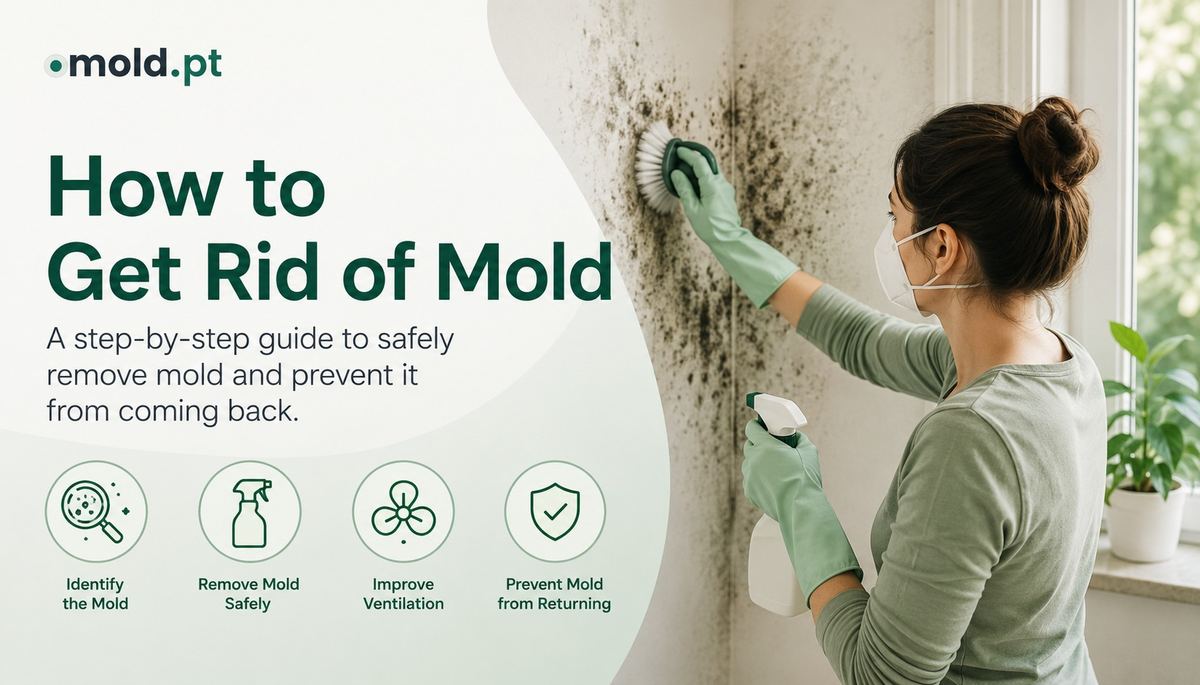
Why Bleach and Repainting Don't Actually Get Rid of Mold
This is the most common mistake property owners in Portugal make with mold: they treat what they can see. A patch of bolor (mold) appears on a bathroom ceiling or a bedroom corner, someone wipes it with bleach or repaints over it, and the problem looks solved, for a while.
The issue is that mold isn't the actual problem. It's a symptom. Mold grows where there's sustained moisture, usually relative humidity above 65% held for 48 hours or more, or a cold surface where condensation forms. Bleach and paint address the visible colony but leave the moisture source completely untouched. Within weeks or months, spores recolonise the same spot, because nothing about the underlying condition changed.
Cleaned it and it keeps coming back?
Mold returns when the moisture source is still there. An inspection finds the source, so the next fix lasts. €695 incl. VAT, written report included.
What's Actually Causing the Mold in Your Property?
These three causes look similar on a wall but need entirely different remediation approaches:
Condensation
humidade de condensação
Warm, moist indoor air meeting a cold surface, common in pre-1990s apartments without mechanical extraction, worsened by thermal bridging (ponte térmica) around window frames and structural beams.
Rising Damp
humidade ascensional
Groundwater drawn up through masonry via capillary action, typically affecting ground-floor walls in older buildings without a damp-proof course.
Penetrating Damp
infiltração
Water entering from a specific defect: a roof leak, failed flashing, cracked render, or a plumbing fault.
Ground-floor apartments in coastal municipalities like Cascais and Sintra tend to show elevated condensation risk, driven by limited cross-ventilation and thermal bridging in older construction. Historic centre properties in Lisboa and Porto more often present rising damp, given solid masonry construction predating modern damp-proofing standards.
How Does mold.pt Diagnose the Real Cause?
Before any remediation is scoped, a diagnostic inspection establishes:
- Moisture mapping, a moisture meter reading across the affected wall or ceiling area, showing the moisture gradient and helping distinguish condensation (surface-level) from rising damp (deeper, base-of-wall concentration)
- Relative humidity logging, a room-level reading to confirm whether ambient humidity is running above the 65% threshold associated with growth conditions
- On-site species testing, identifying what's growing during the visit, which matters because remediation method and health-relevance framing differ by species
- Structural review, checking for the specific defect (missing extraction, damaged flashing, absent damp-proof course) rather than assuming a cause
What Does the Remediation Process Involve?
On-site diagnostic
Moisture mapping and structural review of the affected area.
On-site confirmation
Species identification and humidity logging to confirm cause.
Cause-matched treatment
Extraction, damp-proof course repair, or defect repair, matched to diagnosis.
Clearance testing
Post-remediation testing confirms spore counts return to baseline.
| Cause | Typical Remediation Scope | Starting Range |
|---|---|---|
| Condensation | Mechanical extraction install + affected-material treatment | €800–€1,400 |
| Rising Damp | Damp-proof course repair or injection + structural work | €1,500–€2,200 |
| Penetrating Damp | Defect repair (roof/render/plumbing) + affected-material removal | €900–€2,000 |
Single-room remediation in a Lisbon apartment, dependent on affected area and underlying cause. mold.pt provides transparent starting pricing before work begins, once the diagnostic stage confirms scope.
How Do You Know the Mold Is Actually Gone?
A visual absence of mold isn't proof of resolution, spores can be present in air or on surfaces below the threshold of visible growth. Verification testing after remediation checks whether spore counts have returned to a baseline comparable to unaffected areas of the property, which is the actual measure of whether the moisture source was corrected.
Not sure what's causing the damp?
mold.pt diagnoses the actual cause with moisture mapping before any remediation starts. Inspect. Test. Remediate. Verify. No surprises.
Frequently Asked Questions
Q Can I get rid of mold myself with bleach or vinegar?
Q How long does professional mold remediation take?
Q Does painting over mold get rid of it?
Q Is mold in older Lisbon and Porto apartments always rising damp?
Q What happens if remediation doesn't fully fix the problem?
Conclusion
Getting rid of mold permanently means treating the moisture source, not the colony on the wall. Bleach, vinegar, and repainting can make a room look clean without changing anything about why the mold appeared, which is why it comes back. Confirming the actual cause through moisture mapping and species testing, matching remediation to that cause, and verifying the result with clearance testing is the only sequence that reliably ends the recurrence pattern.
Recurring mold, or a first-time patch you want diagnosed properly?
mold.pt identifies the actual cause with moisture mapping before any remediation starts. Inspect. Test. Remediate. Verify. No surprises.