
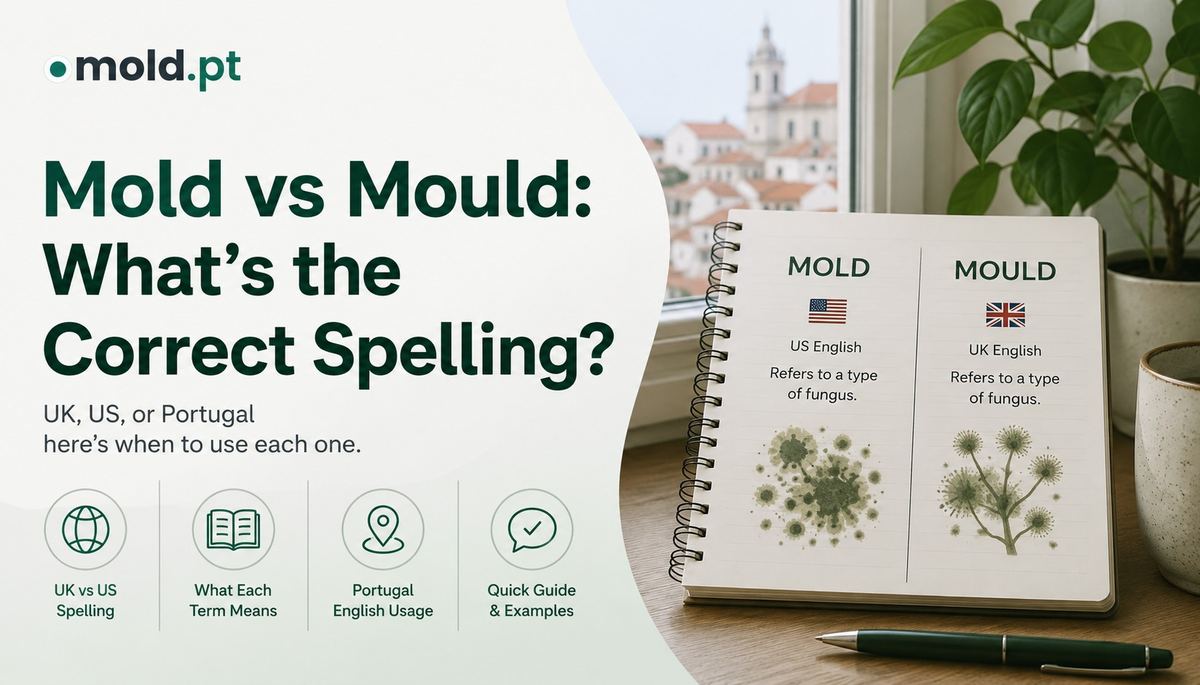
Why Do Mold and Mould Have Different Spellings?
The split isn't unique to this word. "Color" versus "colour," "favor" versus "favour," and "mold" versus "mould" all follow the same pattern, driven largely by Noah Webster's American dictionaries, which deliberately simplified British spelling conventions.
Both words trace back to the same Middle English root, "moulde," referring to a growth of fungus on organic matter. British English preserved the older spelling. American English streamlined it. Neither version is a corruption or a simplification error, they're two branches of the same word that diverged over roughly two centuries of separate editorial standardisation.
For property owners searching online, this means search engines and AI systems generally treat "mold" and "mould" as close synonyms, though regional intent still shapes which spelling shows up in results for a given user.
Is There Any Difference Between Mold and Mould Beyond Spelling?
A property in Cascais with visible fungal growth on a bathroom ceiling has the same underlying condition whether the owner searched "mold removal Portugal" or "mould removal Portugal."
Some marketing content implies a distinction, using "mould" to suggest a more serious variant and "mold" for something more benign, or vice versa. That distinction doesn't exist. Species identification, whether Cladosporium, Aspergillus, or Penicillium, comes from species testing, not from which regional spelling a website uses.
How Do Portuguese Terms for Mold Compare?
The more general and commonly used term across Portugal for visible fungal growth on walls, ceilings, or fabric.
Also widely used, sometimes with a slightly stronger association with musty smell or food spoilage; usage overlaps significantly by region and speaker.
Neither Portuguese term corresponds to a US/UK spelling divide the way mold/mould does. A property owner researching in Portuguese searches "bolor" or "mofo," not a regional variant of the same root word.
Rising damp (humidade ascensional) often produces the conditions that lead to bolor or mofo, particularly in pre-1960s buildings without a damp-proof course.
Why Does mold.pt Use the American Spelling?
Content aimed at British, Irish, or Commonwealth audiences on mold.pt uses "mould" where it improves match with how those users actually search, particularly in FAQ sections and meta descriptions that need to surface for both spelling variants. Both terms appear across mold.pt's content intentionally, to capture search volume from both spelling conventions rather than forcing one regional standard on every visitor.
Recurring damp or visible growth, whatever you call it?
mold.pt is building an evidence-based library on damp and mold in Portuguese homes, sourced and dated.
Does the Spelling Affect Diagnosis or Testing?
Inspect
Same intake, regardless of "mold" or "mould" in the request.
Test
Moisture mapping and species testing, unaffected by spelling.
Remediate
Matched to cause category, not to terminology.
Verify
Clearance testing confirms the fix, whatever it's called.
An inspection booked by a client who typed "mold inspection Lisboa" follows the same Inspect → Test → Remediate → Verify sequence as one booked by a client who typed "mould inspection Lisboa." What does change the diagnostic approach is the cause category, condensation, rising damp, penetrating damp, or a plumbing leak, not the spelling used to describe the visible symptom.
A moisture meter reading and species test return the same result whichever word appears in the inspection report's title.
Frequently Asked Questions
QIs "mold" or "mould" the correct spelling?
QDoes Portugal use "mold" or "mould" in English-language contexts?
QAre "bolor" and "mofo" interchangeable in Portuguese?
QDoes the spelling used in a search change what results come up?
QWill a mold.pt inspection differ depending on which spelling I use when booking?
Conclusion
Mold and mould are the same word, split by a spelling reform that happened roughly two centuries ago, with no difference in the fungus itself, its causes, or how it should be diagnosed. Portuguese speakers use "bolor" or "mofo" instead, terms that don't track the English regional divide. Whichever spelling or language a property owner searches in, mold.pt's diagnostic process stays the same: confirm the cause before recommending a fix.
Recurring damp or visible growth, whatever you call it?
Inspect. Test. Remediate. Verify. No surprises.