
Fixing & Prevention Cluster Guide

Mold and Air Conditioning: Does AC Cause or Prevent Mold?

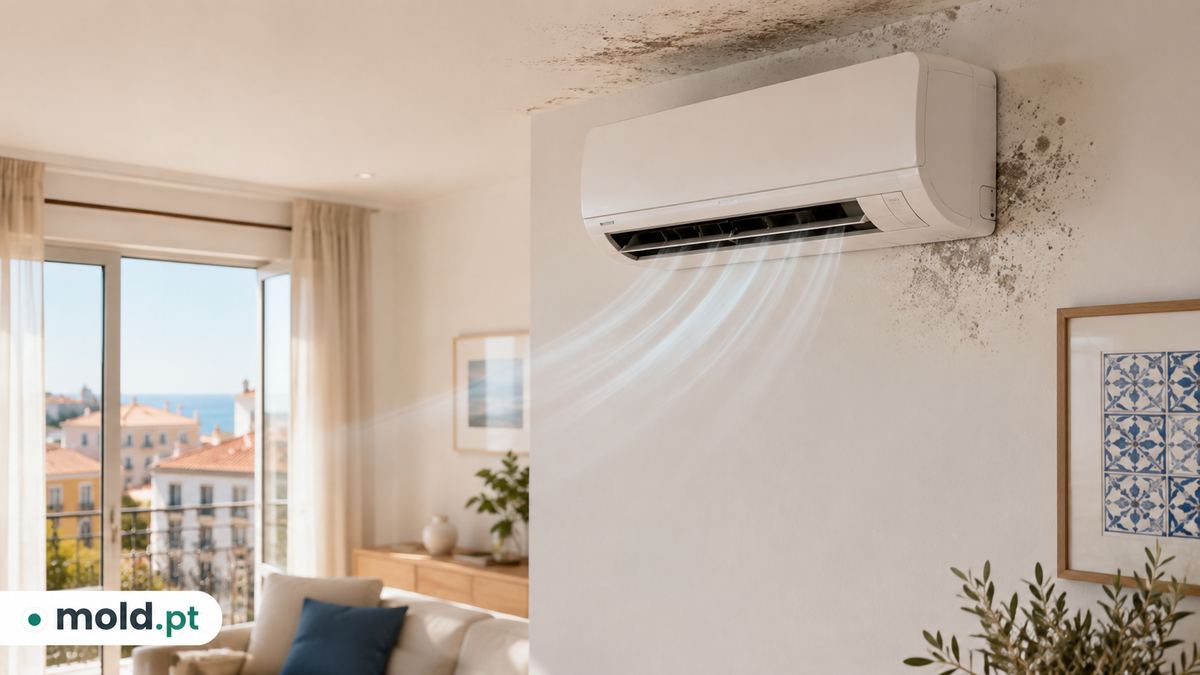
A split-unit air conditioner blowing air toward a wall with visible mold growth around it in a Portuguese home
Quick Answer A correctly sized, well-maintained air conditioner lowers indoor relative humidity and reduces the surface condensation that leads to mold. But the unit itself, specifically the condensation drip tray, drain line, and evaporator coil, sits wet and dark every time it runs, which makes it one of the most commonly overlooked mold sources in Portuguese homes. An AC that's oversized for the room, or one that's rarely cleaned, can end up doing more harm than good.
45–60% RH Target indoor humidity range a working AC should maintain
Drip Tray Most overlooked mold source inside an AC unit
€150 mold.pt remote assessment starting price
✓ Verified Lab-Verified Species Testing

What's in this guide

  • A correctly sized AC unit actively lowers indoor humidity, working against the conditions mold needs
  • The condensation drip tray and drain line inside every AC unit stay wet each time it runs, and rarely get cleaned
  • An oversized unit cools the room fast and shuts off before it has dehumidified the air, leaving a room that's cool but still humid
  • A musty smell when the AC first turns on is one of the clearest signs of mold inside the unit itself
  • mold.pt's €150 remote assessment can help confirm whether a smell is coming from the AC or the wall behind it
In this article
  1. Does Air Conditioning Cause Mold or Prevent It?
  2. Why Does Mold Grow Inside an AC Unit?
  3. How Do You Know If Your AC Has Mold in It?
  4. Can an Oversized AC Unit Make Mold Risk Worse?
  5. How Do You Clean and Maintain an AC to Prevent Mold?
  6. Frequently Asked Questions
  7. Conclusion

Does Air Conditioning Cause Mold or Prevent It?

Quick Answer Air conditioning does both, depending on how it's sized and maintained. A correctly sized unit actively removes moisture from the air as it cools, working directly against the conditions mold needs. A neglected or oversized unit can become a mold source itself, or fail to dehumidify the room properly.

The dehumidifying effect is real and it's not a side benefit, it's built into how cooling works. As warm, humid air passes over an AC's cold evaporator coil, moisture in that air condenses onto the coil and drips away, the same way condensation forms on a cold glass. That's genuinely useful in a country where sustained humidity is a major driver of mold, and it's why a well-run AC can measurably reduce condensation-related mold risk in a room.

The problem is what happens to that condensed moisture afterward, and how the unit behaves when it's sized wrong. Both failure modes are common enough in Portuguese homes that they deserve their own sections below.

i
mold.pt Service Note Split-unit AC is close to universal across Portuguese apartments and houses now, including retrofits into older buildings never designed for it. A unit mounted without proper attention to drain line slope is a common, avoidable source of the internal moisture problems covered below.

Why Does Mold Grow Inside an AC Unit?

Quick Answer The evaporator coil and condensation drip tray inside a split-unit AC stay wet every time the unit runs, and sit inside a dark, enclosed housing with limited airflow, close to ideal conditions for mold. Dust and skin cells pulled through the filter give it something to feed on.
  • The evaporator coil condenses moisture out of the air on every cooling cycle, leaving it wet
  • The drip tray collects that moisture and can hold standing water if the drain line is even partly blocked
  • The indoor unit housing is dark with limited airflow whenever the AC isn't actively running
  • Dust and skin cells pulled through the filter give any mold present something to feed on
  • Inconsistent use, running only on hot days rather than steadily, creates repeated wet-dry cycles that make the problem worse, not better

How Do You Know If Your AC Has Mold in It?

Quick Answer A musty or sour smell when the unit first switches on, visible dark spotting on the vents or fins, and symptoms like sneezing or a stuffy nose that ease when the AC is off are the clearest signs mold has established inside the unit itself.
  • A musty smell specifically when the AC starts up, often fading after a few minutes of running
  • Visible dark spotting on the vents, fins, or drain pan, where you can see them
  • A drip or damp patch on the wall or floor under or near the indoor unit
  • Sneezing, a stuffy nose, or itchy eyes that track specifically with AC use

None of these confirm mold on their own, but the pattern, especially a smell tied specifically to AC startup, is worth investigating. For the wider picture on mold and health, see Can Mold Make You Sick?

Not sure if the smell is coming from the AC or the wall?

mold.pt's remote assessment helps narrow down whether you're dealing with an AC maintenance issue or a moisture problem in the room itself.

Can an Oversized AC Unit Make Mold Risk Worse?

Quick Answer Yes. A unit sized larger than the room needs cools the air quickly and shuts off before it's run long enough to remove much moisture, which can leave a room that feels cool but still has high relative humidity, exactly the condition that favours condensation and mold on nearby walls.

Dehumidification isn't instant, it happens gradually over continuous run time as air keeps passing over the coil. A unit that's too powerful for the room satisfies the thermostat and shuts off within minutes, a pattern called short-cycling, without ever running long enough to pull much moisture out of the air. The room feels cold at first, humidity stays high, and by the time the temperature climbs enough to trigger the AC again, condensation may already be forming on a cold exterior wall nearby.

This is a common, avoidable mistake: some installations size a unit by floor area alone, without accounting for ceiling height, sun exposure, or insulation quality, all of which affect the real cooling and dehumidifying load. Inverter units, which modulate their output instead of switching fully on and off, tend to run longer at lower capacity and dehumidify more effectively than older on/off cycling units of the same rated size.

How Do You Clean and Maintain an AC to Prevent Mold?

Quick Answer Cleaning or replacing the filter every few weeks during heavy use, having the drain line checked at the start of each season, and running fan-only mode for a few minutes after cooling are the three habits that do the most to prevent mold inside a unit.
  • Clean or replace the filter every 2 to 4 weeks during heavy summer use
  • Have the drain line checked and cleared professionally at the start of the season, before heavy use begins
  • Use fan-only mode for 5 to 10 minutes after a cooling cycle ends, to help dry out the coil before the unit sits idle
  • Get the coil professionally cleaned annually if the unit sees heavy seasonal use
  • Avoid running AC at the lowest possible temperature constantly during unoccupied periods; a higher setting with humidity control, where available, is more effective and efficient

Frequently Asked Questions

Q Can I clean AC mold myself, or do I need a professional?
Filters and the visible drain pan can often be cleaned with a vacuum and a mild detergent yourself, but mold on the evaporator coil itself or a blocked internal drain line usually needs a technician with the right access and cleaning agents, since dismantling the unit incorrectly can damage it.
Q Does running the AC constantly prevent mold better than running it occasionally?
Not necessarily. Constant low-level operation can keep humidity steady and low, which helps, but a unit that never gets a dry-out period can stay damp inside continuously; brief fan-only runs after cooling cycles do more for the unit's internal mold risk than nonstop cooling does.
Q Is a dehumidifier better than AC for mold prevention?
They solve different problems: AC cools and dehumidifies as a byproduct, while a dedicated dehumidifier only removes moisture, without cooling. In a Portuguese summer, AC is usually the more practical single solution; a dehumidifier is more useful in a room where you want lower humidity without cooling, like a closed-up storage room or a mild-season damp problem.
Q Can AC mold make you sick?
DGS guidance links poor indoor air quality, including excess humidity and mould, to aggravation of pre-existing respiratory conditions and allergies, and mold blown from an AC unit into a room's air is one route for that exposure; it's an association with aggravating existing sensitivity, not a claim that AC mold causes a specific illness in a healthy person.
Q Should I turn off AC entirely when leaving a property empty for weeks?
Turning it off completely can let humidity climb unchecked in a closed, unventilated property, especially in coastal or higher-risk areas; many owners instead leave it on a higher temperature setting or in a low-power dehumidify mode, which keeps humidity in check without running full cooling while nobody's there.

Conclusion

Air conditioning is a genuine tool against mold, not just a cooling convenience, but only when it's sized correctly and maintained. A unit left uncleaned, or one working too hard and shutting off before it's dehumidified the room, can end up contributing to the same problem it's supposed to help with. If you've ruled out the AC itself and still have a persistent damp smell or visible mold nearby, that points to a moisture source in the building rather than the unit, and it's worth confirming which with a proper diagnostic.

Still smelling something musty after checking the AC?

mold.pt confirms the actual cause with moisture mapping and lab-verified testing before any remediation starts. Inspect. Test. Remediate. Verify.

Version history & last reviewed