
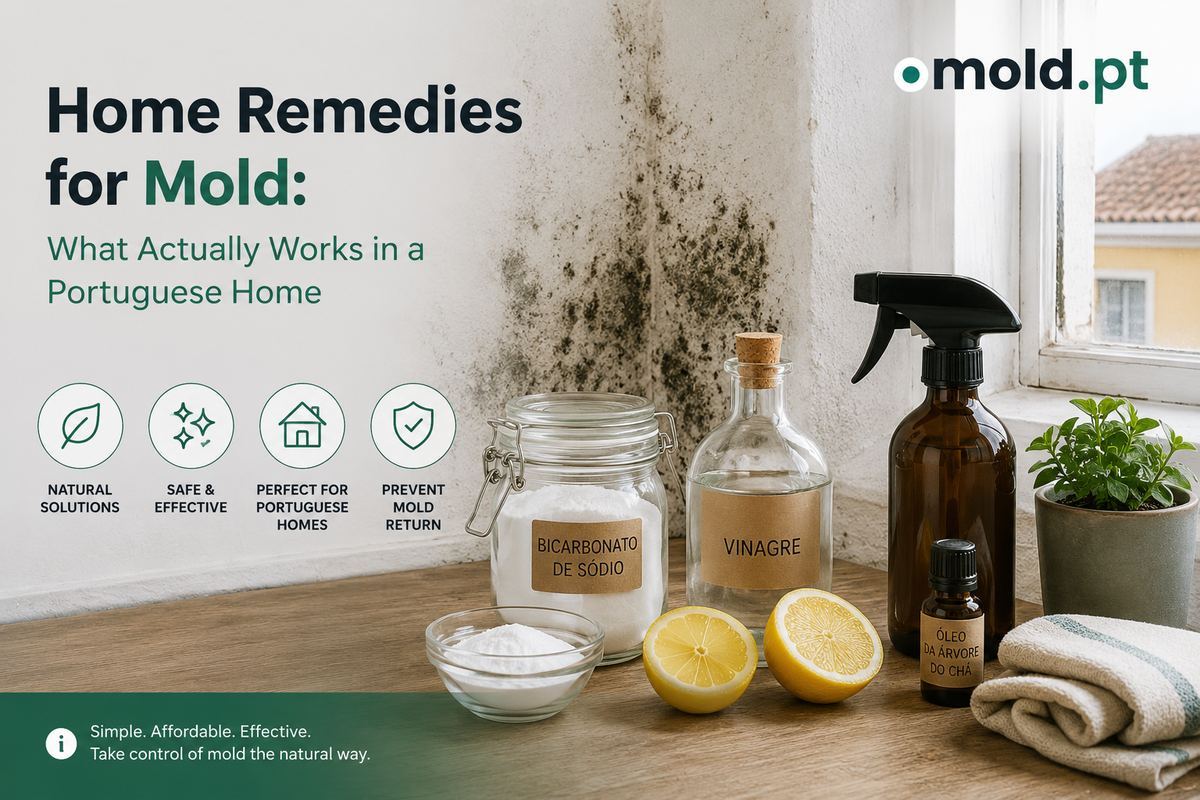
Do Home Remedies Actually Get Rid of Mold?
This is the gap between "the wall looks clean" and "the problem is solved." A patch of bolor (mold) shows up on a bathroom ceiling or a bedroom corner, someone treats it with vinegar or bleach, and it disappears, for a while. Mold itself isn't the actual problem, it's a symptom of sustained moisture: relative humidity above 65% held for 48 hours or more, or a cold surface where condensation forms. A remedy that only touches the visible colony leaves that condition completely untouched.
That doesn't mean home remedies are useless. For a small, first-time patch on a hard surface, they're a reasonable first response. But if the same spot keeps coming back, or if it covers a larger area, the pattern usually points to humidade (dampness) that needs diagnosing, not just cleaning. Our full guide to mold problems in Portuguese housing covers what typically causes recurring damp by building type and region.
Which Home Remedies Work, and on What Surfaces?
The surface matters more than the product. Non-porous materials, tile, glass, sealed countertops, let a remedy sit on top of the mold and act on it directly. Porous materials, drywall, unsealed grout, wood, let mold grow roots below the surface that a topical treatment never reaches, so the colony often returns even after the visible part is gone.
| Remedy | Works Well On | Avoid On | Note |
|---|---|---|---|
| White vinegar (~5% acetic acid) | Tile, glass, sealed countertops | Porous materials, large areas | Mild acidity, no harsh fumes, safe on most hard surfaces |
| Diluted bleach (chlorine) | Non-porous, non-absorbent surfaces | Drywall, wood, grout lines | Bleaches surface colour more than it removes the organism below a porous surface |
| Hydrogen peroxide (3%) | Non-porous and semi-porous surfaces | Coloured fabric (can bleach it) | No persistent fumes; test an inconspicuous spot first |
| Baking soda paste | Light staining, grout, fabric | Active, established growth | Mild abrasive, useful for scrubbing residue after treatment |
| Tea tree or clove oil | Small areas as a follow-up step | Active large-area growth | Common home use, not independently verified against a Portuguese or EU testing standard |
General surface-cleaning guidance, not a substitute for a moisture-source diagnosis. None of these remedies lower a room's relative humidity or correct rising damp, condensation, or a leak.
How Do You Clean Mold Safely at Home?
- Ventilate first, open a window or run extraction before you start, and keep it running during and after cleaning
- Protect yourself, gloves and an N95-type mask reduce contact with spores and cleaning fumes, especially with bleach
- Test a small spot, an inconspicuous patch first, some remedies can discolour paint, grout, or fabric
- Scrub, don't just wipe, a wipe can spread spores across the surface rather than removing them
- Dry the area completely, residual moisture after cleaning is often enough on its own to let mold return within days
When Is a Home Remedy Not Enough?
Beyond that rough size threshold, or when mold is growing inside a wall cavity, behind furniture, under flooring, or inside an HVAC system, a topical remedy generally can't reach or verify the full extent of the problem.
DGS (Direção-Geral da Saúde) guidance links poor indoor air quality, including excess humidity and mould, to aggravation of pre-existing respiratory conditions and allergies, and identifies people with chronic respiratory disease, cardiovascular disease, allergies, children, and the elderly as groups more affected by poor indoor air quality. If anyone in the household falls into one of those groups, it's worth getting the cause confirmed rather than relying on repeat cleaning.
Not sure if this is a DIY job?
mold.pt's €695 diagnostic gives you a documented cause before you commit to more cleaning or a full remediation.
Why Does Mold Keep Coming Back After You Clean It Yourself?
This is the same pattern professional remediation is built to avoid. mold.pt's process follows four stages, and it's worth understanding even if you're planning to clean the patch yourself first:
On-site diagnostic
Moisture mapping and structural review of the affected area.
On-site confirmation
Species identification and humidity logging to confirm cause.
Cause-matched treatment
Extraction, damp-proof course repair, or defect repair, matched to diagnosis.
Clearance testing
Post-remediation testing confirms spore counts return to baseline.
If a home remedy handles a small, one-off patch and it doesn't come back, that's a reasonable outcome. If it returns once, twice, or keeps spreading, the four-stage process above is what actually breaks the cycle, see our full breakdown in How to Get Rid of Mold (and Why Most DIY Fixes Don't). mold.pt covers this in Mold Inspections across Lisboa, Porto, and the wider country.
Frequently Asked Questions
Q Does vinegar really kill mold?
Q Is bleach or vinegar better for mold?
Q How much mold is too much to clean myself?
Q Can I use tea tree oil or other essential oils for mold?
Q Will mold come back after I clean it with a home remedy?
Conclusion
Home remedies have a real, limited role: a small, first-time patch of mold on a hard, non-porous surface, cleaned promptly and dried completely, often doesn't need anything more. Past that, on a porous material, over roughly 10 square feet, or recurring after a first cleaning, the product stops being the variable that matters. The moisture source is. Confirming that source with moisture mapping and testing, then matching the fix to the actual cause, is the only sequence that reliably stops mold from coming back.
Cleaned it once already, and it's back?
mold.pt identifies the actual cause with moisture mapping before any remediation starts. Inspect. Test. Remediate. Verify. No surprises.