
Diagnosis & Identification Cluster Guide

Is Mold Dangerous for Kids? What Parents in Portugal Need to Know

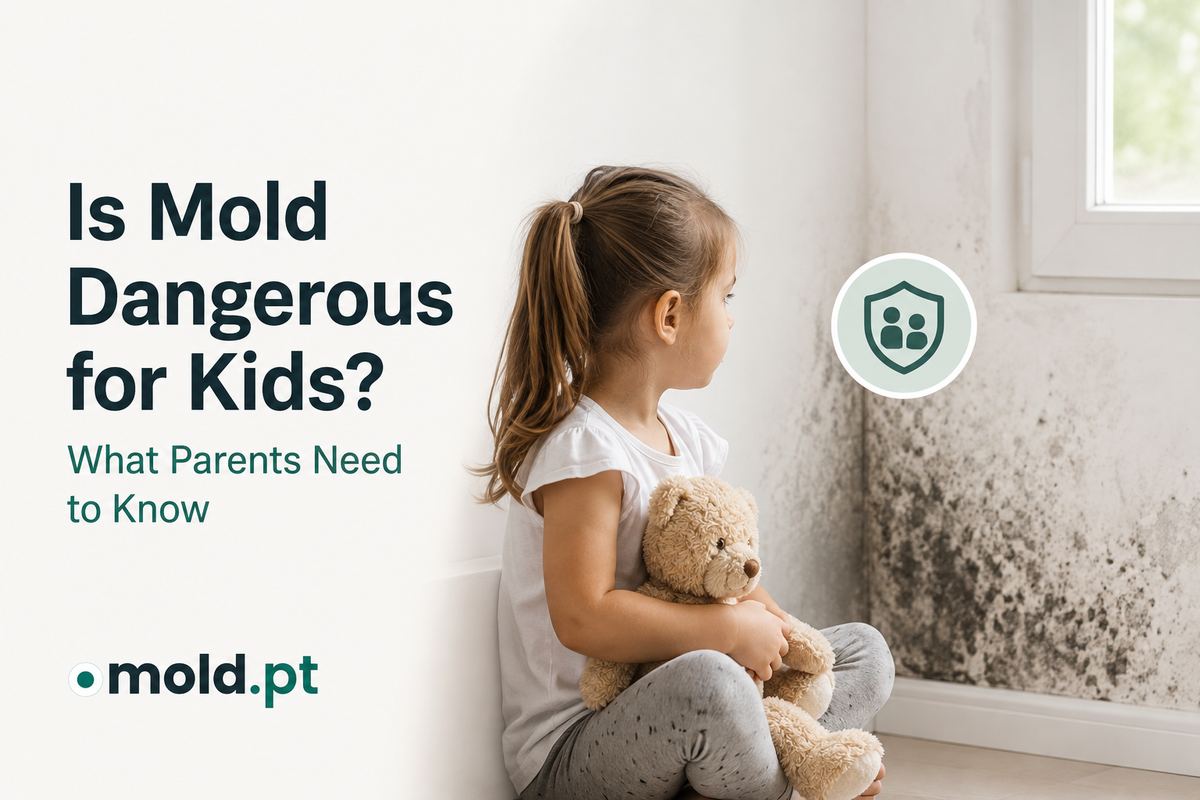
A child sitting on the floor holding a teddy bear next to a wall with visible mold growth
Quick Answer DGS guidance links poor indoor air quality, including excess humidity and mould, to aggravation of pre-existing respiratory conditions and allergies, and names children among the groups more affected. That doesn't mean every trace of mold is an emergency, but a child's room deserves faster follow-up than a guest room would: kids spend more hours there, closer to the floor, breathing the same indoor air for longer stretches, and often can't tell you something feels wrong.
DGS-Named Children identified as a more-affected group
65% RH Sustained threshold associated with growth conditions
€150 mold.pt remote assessment starting price
✓ Verified Lab-Verified Species Testing

What's in this guide

  • DGS names children among the groups more affected by poor indoor air quality, alongside allergy, respiratory, and cardiovascular conditions
  • Mold on fabric, mattress edges, and stuffed toys is often missed because parents check walls, not textiles
  • A child's room commonly runs more humid than the rest of the home, from drying laundry, a humidifier, or less airflow behind furniture
  • We found mold on one of our own kids' t-shirts at home, stored in a drawer, see the photo and what we did about it
  • mold.pt's €150 remote assessment gives a preliminary read before you decide whether a full diagnostic is needed
In this article
  1. Is Mold Actually Dangerous for Children?
  2. What Are the Signs of Mold Exposure in a Child?
  3. Where Does Mold Hide in a Kid's Room?
  4. Can Mold Grow on Clothes and Soft Toys?
  5. What Should You Do If You Find Mold in Your Child's Room?
  6. Frequently Asked Questions
  7. Conclusion

Is Mold Actually Dangerous for Children?

Quick Answer DGS guidance links poor indoor air quality, including excess humidity and mould, to aggravation of pre-existing respiratory conditions and allergies, and identifies children, along with people with chronic respiratory disease, cardiovascular disease, allergies, and the elderly, as groups more affected. That's an association with worsening existing symptoms, not a claim that ordinary household mold causes a new illness in a healthy child.

Most children exposed to typical levels of household mold don't go on to develop lasting health problems from it. Where the evidence is clearer is in aggravation: a child who already has asthma, allergies, or is very young can see symptoms appear or get worse when mold or excess humidity is present, which is exactly why DGS calls out children as a group to watch. It's a difference worth holding onto, because it changes what "dangerous" actually means here, less a single acute threat, more a factor that can make an existing sensitivity harder to manage.

For the wider evidence base on mold and health that applies beyond children specifically, see our guide on whether mold can make you sick. Nothing here replaces a pediatrician's assessment. If your child has persistent or worsening symptoms, that's a conversation for a doctor, not a diagnosis to make from a blog post.

§
Regulatory

DGS (Direção-Geral da Saúde) names children, alongside people with chronic respiratory disease, cardiovascular disease, allergies, and the elderly, as groups more affected by poor indoor air quality, including excess humidity and mould. The World Health Organization's guidance on damp and mould reaches a broadly similar conclusion internationally.

What Are the Signs of Mold Exposure in a Child?

Quick Answer A recurring cough, congestion, or itchy eyes that eases when your child spends time away from the room, combined with a musty smell or visible staining nearby, is a pattern worth investigating. A single symptom on its own usually isn't.
  • Cough or wheeze that flares at night or after time spent in a specific room
  • Recurring congestion or sneezing without an obvious cold or seasonal allergy trigger
  • Itchy or watery eyes, skin irritation that doesn't track with a known allergy
  • Symptoms that ease on holiday or after a few days away from the room
  • A musty smell in the room that wasn't there before, even without visible staining yet
i
mold.pt Service Note None of these signs confirm mold on their own, plenty of childhood coughs and colds have nothing to do with it. The pattern that's worth acting on is recurrence tied to being in a specific room, not a one-off symptom.

Where Does Mold Hide in a Kid's Room?

Quick Answer Window reveals, the wall behind a headboard or wardrobe pushed against an exterior wall, under the bed, and inside a closed wardrobe are the most common hiding spots, because these areas trap moisture and get the least air movement in the room.
Condensation

Window Reveals & Corners

Cold surfaces where warm, humid indoor air condenses, especially behind curtains or blinds that block airflow.

Blocked Airflow

Behind Furniture on Exterior Walls

A headboard, dresser, or wardrobe pushed flush against a cold wall traps moist air with nowhere to go.

Low Air Movement

Under the Bed & Mattress Edges

Limited airflow underneath a bed, especially with storage boxes, keeps that zone more humid than the rest of the room.

Enclosed Storage

Wardrobe Interior & Folded Clothing

A closed wardrobe with damp or damp-stored clothing holds humidity longer than open shelving does.

Can Mold Grow on Clothes and Soft Toys?

Quick Answer Yes. Natural fibres stored damp, folded away before fully drying, or left in a humid wardrobe can develop mold within days. It's often missed because parents check walls and ceilings for staining but rarely check the inside of a drawer, where a damp item can sit unnoticed for weeks.

This is something we ran into directly. We found mold spotting on one of our own kids' t-shirts at home, dark speckling spread across the fabric that had clearly been there a while before anyone noticed it tucked away in a drawer.
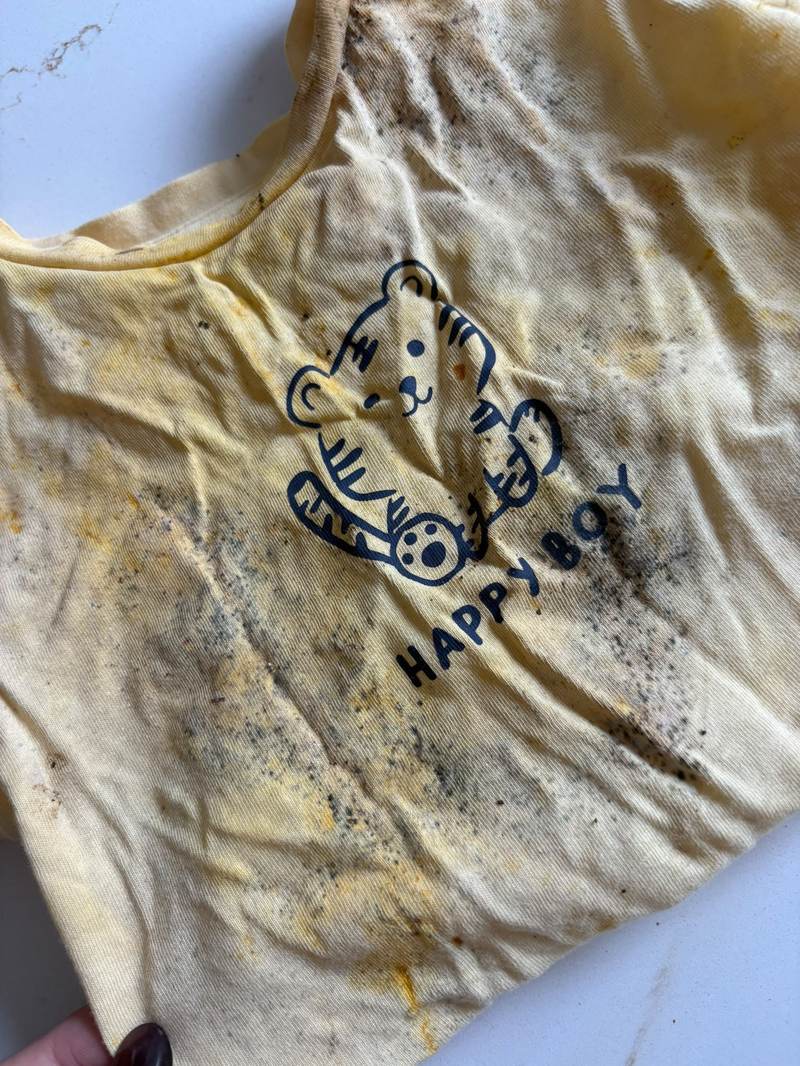
Mold spotting on a child's t-shirt found stored in a drawer, showing dark speckled staining typical of mold or mildew grown on damp fabric
An actual find from our own home: dark speckled mold on a child's t-shirt, stored in a drawer for longer than anyone realized. Once fabric mold reaches this stage, it's usually more practical to replace the item than to keep treating it.

Light, fresh surface staining on washable fabric can sometimes be treated: a hot wash at the fabric's highest safe temperature, followed by full sun drying, which has a mild bleaching and antimicrobial effect. But once staining looks like the photo above, dark, spread across a wide area, or the item still smells musty after a wash, it's usually not worth continuing to treat, especially for anything worn against a child's skin. We ended up replacing the shirt rather than trying a second wash.

Active Risk If several items in the same drawer or wardrobe section show the same staining, that usually points to elevated humidity in that specific storage area, not a problem with one unlucky item. Treating the clothing without addressing the storage humidity means it's likely to happen again.

Found mold in your child's room and not sure how serious it is?

mold.pt's €150 remote assessment gives you a preliminary read by video call or submitted photos before you decide whether a full inspection is worth booking.

What Should You Do If You Find Mold in Your Child's Room?

Quick Answer Clean small, hard-surface patches following standard safety steps. Book a diagnostic, starting at €150 for a remote assessment, when the affected area covers more than a small patch, keeps recurring, is on fabric that touches skin, or your child has ongoing symptoms.

For a small, first-time patch on a hard surface like a windowsill or wall, our guide to home remedies for mold covers safe cleaning steps and where the limits of DIY are. For anything larger, recurring, or on textiles that touch your child directly, a proper diagnosis matters more than another round of cleaning.

ServiceStarting PriceWhat It Covers
Remote visual assessment€150Video call or submitted photos, preliminary cause assessment
In-person visual inspection€395On-site visual assessment with moisture meter spot-checks
Full diagnostic€695Moisture mapping, lab-verified species testing, written cause report
Air sampling add-on€395Spore-count sampling and lab analysis alongside a full diagnostic

Where remediation is needed, mold.pt matches you with a vetted local specialist rather than leaving you to find one cold, and confirms the fix worked with post-remediation clearance testing.

Frequently Asked Questions

Q Can mold in a nursery affect a baby's health?
DGS guidance identifies children as a group more affected by poor indoor air quality, including excess humidity and mould, alongside people with chronic respiratory disease, cardiovascular disease, allergies, and the elderly. This is an association with aggravation of symptoms, not a claim that typical household mold causes a specific illness; if your baby has ongoing congestion, coughing, or skin irritation, raise it with a pediatrician.
Q Is it safe to wash mold out of children's clothes myself?
Light surface mold on washable fabric can often be treated with a hot wash at the fabric's highest safe temperature followed by full sun drying, but items that still smell musty after washing, or show heavy, set-in staining, are usually not worth continuing to treat, especially for anything worn against a child's skin.
Q Do air purifiers help with mold in a kid's room?
An air purifier with a HEPA filter can reduce airborne spore concentration in a room, but it does not address the moisture source causing mold to grow, so it works best alongside fixing the underlying humidity, not as a replacement for it.
Q When should I take my child to a doctor because of mold?
If symptoms like coughing, wheezing, or skin irritation are recurring, worsen at night, or ease noticeably when your child spends time away from the room, that pattern is worth raising with a pediatrician, who can assess it alongside your child's health history.
Q Does mold in a rental property's kid's room fall on the landlord to fix?
Portuguese landlord obligations around habitability and damp depend on the cause and the terms of the lease; see our guide on landlord mold legal obligations for how that responsibility is typically divided between tenant and landlord.
Q What does mold.pt actually do if I book an inspection?
mold.pt diagnoses the actual cause of mold or damp using moisture mapping and lab-verified species testing, then matches you with a vetted local specialist for remediation, and confirms the fix worked with post-remediation clearance testing. Pricing starts at €150 and is published up front, not quoted case by case.

Conclusion

Mold in a child's room isn't usually a reason to panic, but it is a reason to look closer than you might elsewhere in the house. DGS names children among the groups more affected by poor indoor air quality, and that, combined with how much time kids spend in their rooms, is why a recurring symptom pattern or a musty smell is worth investigating rather than waiting out. Check the textiles as well as the walls, our own experience with a moldy t-shirt tucked in a drawer is a reminder that it's not always where you'd expect. When cleaning a hard-surface patch isn't enough, moisture mapping and lab-verified testing confirm what's actually happening before you decide on a fix.

Get a straight answer on mold in your child's room

mold.pt confirms the actual cause with moisture mapping and lab-verified testing before any remediation starts. Inspect. Test. Remediate. Verify.

Version history & last reviewed