
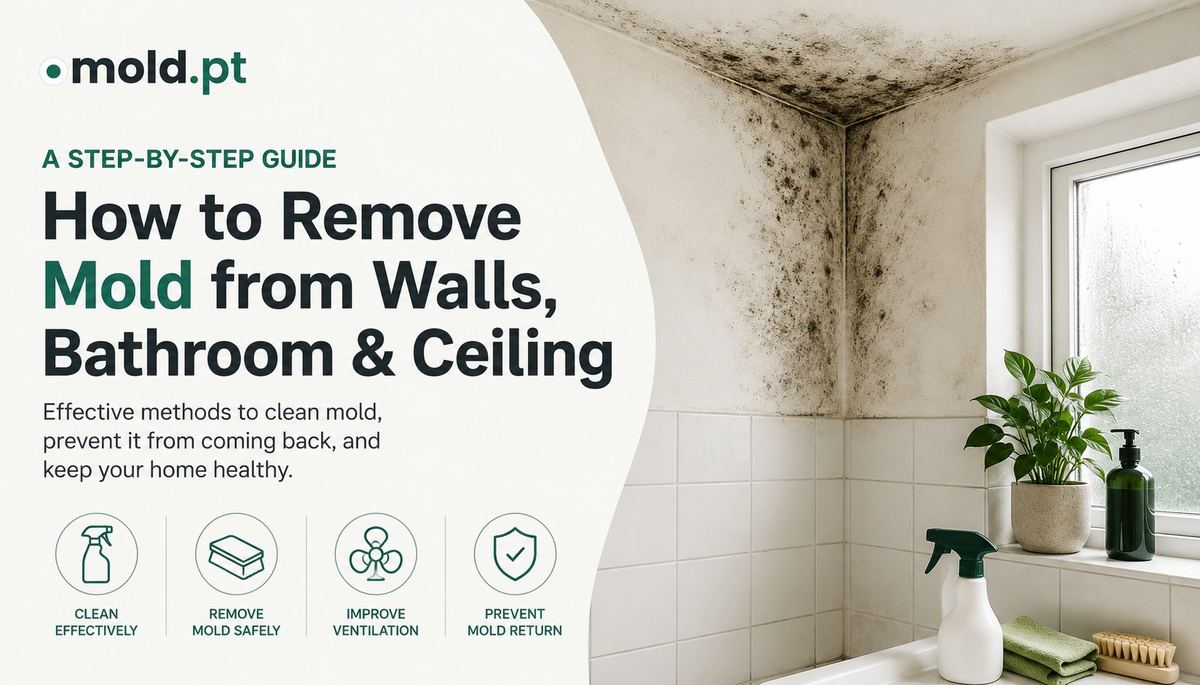
Why Location Changes What's Actually Causing the Mold
Property owners often search for one universal way to remove mold, but the location tells a diagnostic story. A moisture meter reading, humidity log, and visual pattern behave differently on a bedroom wall than on a bathroom tile line or a ceiling corner, and treating all three the same way is a common reason mold returns after a first attempt.
This guide breaks removal down by surface, then covers when cleaning alone is genuinely sufficient versus when it's a temporary mask over an unresolved source. For the full diagnostic and remediation sequence mold.pt uses across all surface types, see how to get rid of mold properly.
How Do You Remove Mold from a Wall?
Wall mold falls into two common patterns:
Condensation (humidade de condensação)
Concentrated where thermal bridging (ponte térmica) creates a cold surface, often near window reveals or where an external wall meets a concrete structural element.
Rising Damp (humidade ascensional)
Typically confined to ground-floor external walls in older construction without a damp-proof course, often accompanied by salt staining rather than pure discolouration.
For condensation-pattern wall mold, wiping the affected area with a mold-appropriate cleaner removes the visible colony, but regrowth is common unless mechanical extraction or improved ventilation addresses the humidity driving it. For rising-damp-pattern wall mold, surface cleaning does essentially nothing, the moisture source is inside the wall structure, and remediation requires damp-proof course repair or injection, not a cleaning product.
How Do You Remove Mold from a Bathroom?
Bathrooms generate the highest sustained humidity of any room in a Portuguese apartment, and pre-1990s buildings were frequently constructed without mechanical extraction at all, window ventilation alone rarely clears post-shower humidity fast enough to stay below the 65% relative humidity threshold associated with growth.
- Clean grout lines, silicone sealant, and tile surfaces with a mold-appropriate cleaner, working the full affected area rather than just the darkest patches
- Replace silicone sealant around the shower or bath if mold has penetrated the material itself, cleaning surface-level mold off degraded sealant is usually temporary
- Confirm whether mechanical extraction exists and is sized for the room; a fan that's present but undersized or improperly ducted produces the same recurrence pattern as no fan at all
- Log relative humidity across a typical week of use rather than assuming a single reading tells the full story
How Do You Remove Mold from a Ceiling?
Ceiling mold requires a different first check than wall or bathroom mold: whether the moisture originates from the room itself (condensation) or from above (penetrating damp).
Condensation-Driven
Typically appears in bathrooms and kitchens near extraction points or in corners with limited air movement; responds to the same extraction and ventilation fixes as wall condensation.
Leak-Driven
Often a discoloured patch with an irregular edge, sometimes with visible staining rather than uniform growth, can appear with no connection to bathroom or kitchen humidity.
Not sure what's causing the damp?
mold.pt diagnoses the actual cause with moisture mapping before any remediation starts. Inspect. Test. Remediate. Verify. No surprises.
When Does Surface Cleaning Actually Work?
There are cases where cleaning is the complete fix: a small, isolated patch that appeared after a specific event (a closed window during a humid week, a one-off leak that's already been repaired) with no recurrence and no elevated ambient humidity. In that scenario, a mold-appropriate cleaner removes the colony and there's nothing left to treat.
Frequently Asked Questions
Q What's the best product to remove mold from a wall myself?
Q Why does bathroom mold keep coming back even though I clean it every week?
Q Is ceiling mold in a bathroom dangerous compared to other rooms?
Q Can I tell the difference between condensation and rising damp just by looking at the wall?
Q Should I remove and replace ceiling material with visible mold, or just clean it?
Conclusion
There's no single universal method for removing mold, because a wall, a bathroom, and a ceiling each point toward different likely causes, condensation, rising damp, missing extraction, or a hidden leak. Cleaning the visible colony is only ever half the job; confirming which moisture source is actually present is what determines whether the fix holds. For the full diagnostic sequence mold.pt applies across every surface type, see how to get rid of mold properly.
Mold on a wall, in the bathroom, or on the ceiling that keeps coming back?
mold.pt identifies the actual moisture source with moisture mapping before any remediation starts. Inspect. Test. Remediate. Verify. No surprises.