
Buying & Renting Cluster Guide

Mold in Airbnb & Short-Term Rental Properties: What Hosts in Portugal Need to Know

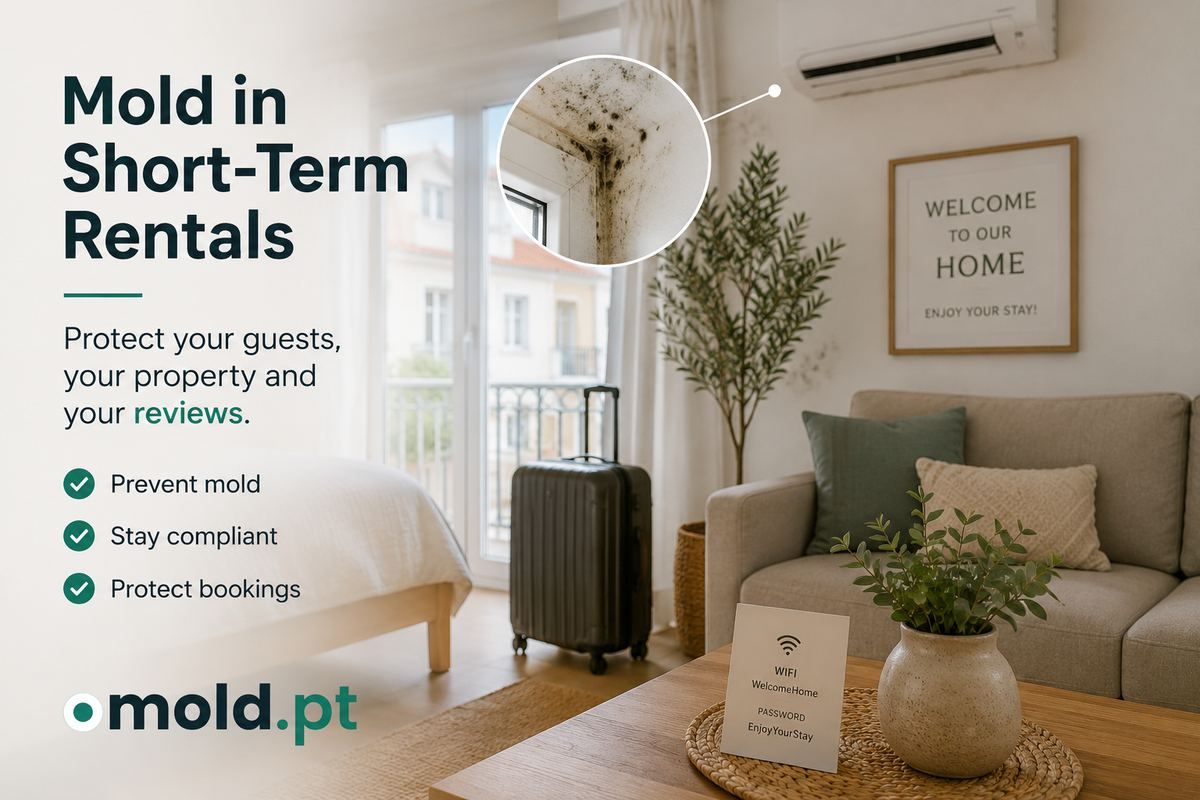
A short-term rental bedroom with a suitcase and a magnified view showing mold growth in a corner near the window
Quick Answer Mold in a short-term rental surfaces differently than in a long-term let: instead of a tenant mentioning it privately, it shows up as a guest complaint mid-stay or, worse, in a public review after checkout. Properties left closed between bookings, with AC running only when occupied, are at particular risk. Building a mold check into every turnover, not just responding when a guest flags it, is the difference between a quiet fix and a damaged listing.
Between Bookings When most AL mold problems develop unnoticed
1 Review Can affect a listing long after the issue is fixed
€150 mold.pt remote assessment, before or after a complaint
✓ Verified Written Report You Can Show a Guest or Insurer

What's in this guide

  • A short-term rental left closed between bookings can build humidity for days before anyone notices
  • A single mold-related review can affect a listing's standing long after the issue itself is fixed
  • Guests are far more likely to complain, or leave a review, than a long-term tenant who might mention it in passing
  • A written diagnostic report gives hosts something concrete to show a guest, an insurer, or a future buyer
  • Building a mold check into cleaning turnover, not waiting for a complaint, catches most issues before a guest ever sees them
In this article
  1. Why Is Mold Riskier for Short-Term Rentals Than Long-Term Lets?
  2. What Do Guests Complain About, and How Fast Does It Become a Review Problem?
  3. Where Should Hosts Check Between Bookings?
  4. What Are a Host's Legal and Liability Obligations?
  5. How Do You Build Mold Checks Into a Turnover Routine?
  6. Frequently Asked Questions
  7. Conclusion

Why Is Mold Riskier for Short-Term Rentals Than Long-Term Lets?

Quick Answer A long-term tenant living in a property day to day tends to notice and mention a damp patch early. A short-term rental sits empty between bookings, sometimes for days or weeks, with no one there to notice a leak, a blocked AC drain, or rising humidity until the next guest checks in and finds it.

Occupancy pattern is the core difference. A tenant who lives somewhere full-time will usually flag a musty smell or a new stain well before it becomes a serious problem, often informally, in a message to the landlord. A short-term rental has no one present most of the time. Windows stay shut, AC often only runs when a guest books it on, and there's no daily airing out, exactly the closed-up conditions that let humidity climb.

Many Alojamento Local properties also sit in the same older, historic-centre buildings that already carry elevated structural risk, precisely because tourists want to stay in character-filled central apartments in Lisboa, Porto, and other historic areas.

i
mold.pt Service Note A property that sits closed for two weeks between bookings in a coastal or historically damp area can develop noticeable condensation in that window alone, even if it was completely fine at the last checkout.

What Do Guests Complain About, and How Fast Does It Become a Review Problem?

Quick Answer Musty smell in a bedroom or bathroom, visible spotting on grout or ceiling corners, and a bathroom that never seems to fully dry out are the most common guest complaints. A mid-stay message can often be resolved quietly; anything discovered at checkout tends to end up in the public review instead.
  • A musty or stale smell noticed on arrival, especially in a bedroom or closed-off area
  • Visible dark spotting on bathroom grout, ceiling corners, or around windows
  • A bathroom or towel that stays damp long after a shower, suggesting poor extraction
  • A smell or spotting that develops partway through a longer stay

Timing matters more than most hosts expect. A guest who messages mid-stay is usually giving you a chance to fix it before they leave a review, and a fast, visible response often prevents the complaint from ever reaching the review itself. A guest who only notices it while packing up, or who decides it's not worth messaging about, is far more likely to just mention it in the review afterward.

Where Should Hosts Check Between Bookings?

Quick Answer Bathroom extraction, AC drip trays and drain lines, and closets or drawers where linens might have been put away damp are the three places hosts most often miss during a standard cleaning turnover, precisely because none of them show up in a quick visual scan of the room.
  • Bathroom extractor fan, confirm it's actually running and clearing steam, not just present
  • AC unit drip tray and drain line, a common internal mold source; see our guide on mold and air conditioning for what to look for
  • Wardrobes and drawers where towels or linens are stored, especially in a property that's been closed up
  • Window reveals and corners, particularly in ground-floor or north-facing units
  • Under sinks and around washing machine connections, if the property has one

Found something during a turnover check?

mold.pt confirms the cause and matches you with a vetted local specialist for the fix, without disrupting your booking calendar more than necessary.

What Are a Host's Legal and Liability Obligations?

Quick Answer Alojamento Local properties are expected to meet baseline habitability standards, and a guest raising a health complaint linked to mold exposure could escalate it with the platform or, in a serious case, pursue a claim, so documenting the property's condition matters more for AL hosts than it would for a private long-term let.

The general Portuguese legal framework around damp, mold, and habitability is the same one that applies to any rented property, covered in more depth in our guide to landlord mold legal obligations. AL registration adds its own layer of habitability expectations on top of that, since a licensed short-term rental is presenting itself to the public as fit for immediate occupancy, not just meeting the baseline standard of a private tenancy.

How individual booking platforms handle habitability complaints varies and changes over time, so this isn't the place to rely on specifics of any one platform's policy; check your platform's current terms directly. What's consistent regardless of platform is that documentation helps: dated photos, a written diagnostic report, and records of any remediation give you something concrete if a guest, an insurer, or a platform ever asks about the property's condition.

§
Regulatory

DGS (Direção-Geral da Saúde) guidance links poor indoor air quality, including excess humidity and mould, to aggravation of pre-existing respiratory conditions and allergies. A guest disclosing a relevant health condition after a stay is a scenario worth having documentation ready for, even if it's uncommon.

How Do You Build Mold Checks Into a Turnover Routine?

Quick Answer Adding a short smell-and-visual check, bathroom, AC unit, and window reveals, plus drying towels fully before storage, to the standard cleaning turnover catches most problems before the next guest arrives, and it costs a few extra minutes per turnover against the cost of a bad review.
  • Have cleaners do a quick smell check on entry, before opening windows, since airing out can mask a smell that would otherwise be noticed
  • Visually check bathroom grout, ceiling corners, and the AC unit's visible drain pan every turnover
  • Make sure towels and linens are fully dry before being folded into closed storage
  • Run the AC or open windows for at least an hour before a new guest's arrival if the property has sat closed since the last checkout
  • Book a professional check once or twice a year, or after any extended closed period, rather than only after a complaint

Frequently Asked Questions

Q Should I get a mold inspection before listing a new short-term rental?
It's a reasonable step for any older property, or one that's been vacant for a while before listing, since confirming there's no active moisture problem before your first guest arrives is cheaper than dealing with a mid-stay complaint or a bad review after the fact.
Q Can a single guest complaint really affect my Airbnb ranking?
A single resolved mid-stay complaint usually has limited lasting effect, but a public review mentioning mold, damp, or a musty smell can influence how future guests perceive the listing for as long as that review remains visible, which is why catching problems before checkout matters more than fixing them after.
Q Is mold covered by short-term rental or AL insurance in Portugal?
Coverage varies by policy and, as with most home insurance, gradual damage from long-term moisture exposure is often treated differently from sudden damage like a burst pipe; check your specific AL policy's terms, and keep in mind that our broader guide on landlord obligations covers the general Portuguese legal framework.
Q How often should an AL property get a mold check?
A visual check at every cleaning turnover catches most issues early; a more thorough professional check once or twice a year, or after any period the property sat empty for several weeks, is a reasonable baseline for most short-term rentals.
Q What should I say to a guest who complains about a musty smell mid-stay?
Acknowledge it promptly, offer to have someone look at it that day if possible, and follow up once you know the cause. A fast, transparent response to a mid-stay complaint is far less likely to end up in a review than a complaint that goes unanswered until checkout.

Conclusion

Mold behaves the same way in a short-term rental as anywhere else, it's driven by moisture, not by how the property is used. What's different is how fast it becomes visible to other people, and how public the consequences are. A quick, consistent turnover check catches most problems before a guest ever notices, and when something does turn up, a confirmed cause and a written report protect you far better than a guess and a repaint.

Get ahead of a mold problem before a guest finds it

mold.pt confirms the actual cause with moisture mapping and lab-verified testing before any remediation starts. Inspect. Test. Remediate. Verify.

Version history & last reviewed