
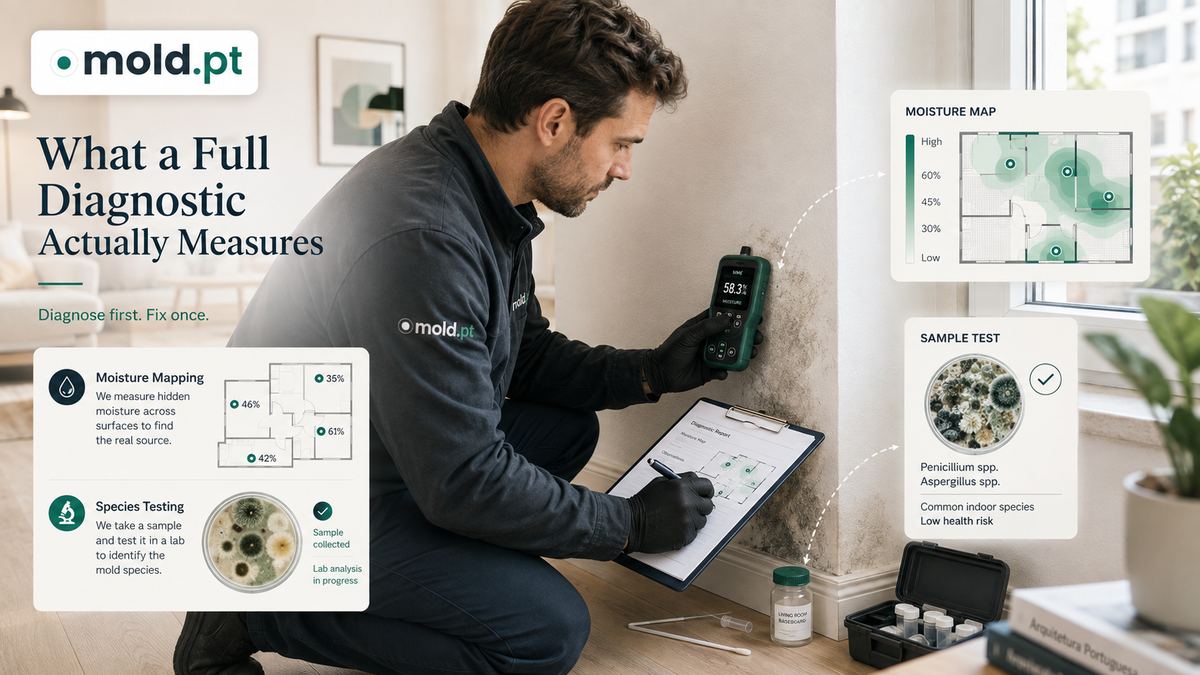
Why the Diagnostic Matters Before Any Remediation Starts
Condensation is routinely treated as rising damp and vice versa. The two look similar on a wall, a dark patch near the skirting board or around a window frame, but they have different sources and need different fixes. Repainting or bleaching the visible mold addresses the stain, not the moisture behind it. Without a diagnosed cause, a remediation crew is guessing, and property owners in Lisboa, Cascais, and Porto commonly report the same patch reappearing within a year of a first "fix" that was never tested.
A diagnostic replaces that guess with a moisture map and an on-site species result. It's the step that separates a €400 ventilation correction from a €3,000+ structural remediation, because it tells you which one the property actually needs. See our full breakdown of mold remediation costs in Portugal for how that plays out across cause types.
What Does Moisture Mapping Actually Measure?
A single moisture reading on a wall tells you almost nothing on its own. What matters is the pattern: how the reading changes as the meter moves from the skirting board upward (a rising damp signature), how it correlates with a cold external wall (a thermal bridging signature typical of condensation), or whether it clusters around a specific pipe run or roof penetration (a plumbing or penetrating damp signature). mold.pt's inspectors record ambient relative humidity, surface temperature, and material moisture content across the affected room and at least one unaffected control area, so the report shows contrast, not just a number.
Pre-1990s Portuguese apartments were built without mechanical extraction, which means moisture mapping in these properties frequently shows elevated readings concentrated in bathrooms and kitchens even where no leak exists, a ventilation-driven pattern rather than a structural one. Ground-floor apartments in coastal municipalities show a different pattern again, with elevated condensation risk from thermal bridging and limited cross-ventilation.
What Does On-Site Species Assessment Add That a Visual Check Can't?
A visual inspection can tell you mold is present. It generally can't tell you whether that mold is currently growing, which matters because active growth means an ongoing moisture source that needs to be found and fixed, while dormant residue on a surface that's been dry for months may only need cleaning. Species assessment, paired with the moisture mapping data, is what lets mold.pt's inspectors make that distinction in the written report rather than as a verbal guess.
For cases where airborne exposure is the concern rather than surface growth, air sampling is available as a €395 add-on to the full diagnostic. It measures spore counts in the air rather than on a surface and is never sold as a standalone service, since spore-count data is only meaningful alongside the moisture and material findings from the same inspection.
Not sure if you need species assessment?
mold.pt's inspectors can tell you what your specific situation needs before you book.
What's Inside the Written Cause Report?
The report includes the humidity and material readings by location, the species assessment result, photographs of the affected area, and a plain-language conclusion: what's causing the problem and where. This is the document a property owner takes to a remediation contractor, or that mold.pt itself uses to scope the remediation stage if the client continues with mold.pt's own process. It's also the reference point for post-remediation clearance testing later, since clearance testing compares new readings against this original baseline.
How Much Does a Full Diagnostic Cost?
| Service | Price | What's Included |
|---|---|---|
| Full diagnostic | €695 | Moisture mapping, on-site species assessment, written cause report |
| Air sampling add-on | €395 | Spore-count sampling and analysis alongside a full diagnostic |
For context, a single-room mold remediation in a Lisboa apartment typically runs €800–€2,200 depending on affected area and underlying moisture source, so the €695 diagnostic is what determines which end of that range, or whether remediation is needed at all, applies to a given property.
How Does the Diagnostic Fit Into Inspect, Remediate, Verify?
Without a diagnosed cause, remediation work, typically ventilation correction or structural repair, is guesswork. The moisture map and on-site species result determine whether a property needs a €400 extraction fan corrected into the bathroom or a full damp-proof course repair. Post-remediation clearance testing then compares new readings against this diagnostic's baseline, confirming the moisture source was actually resolved rather than just the visible mold.
DGS (Direção-Geral da Saúde) guidance states that excess indoor humidity leads to condensation on cold surfaces, which can produce mould and negative effects for occupants, and notes that people spend 80–90% of their time indoors. This general guidance is the basis for treating humidity control as a genuine health-adjacent maintenance issue in Portuguese housing, not just a cosmetic one, without attributing any specific illness to any specific reading.
Frequently Asked Questions
Q Is species testing always necessary, or is moisture mapping enough on its own?
Q How long does a full diagnostic take?
Q Does the diagnostic price include remediation?
Q Can I use the cause report with a different contractor?
Q Is air sampling included in the full diagnostic?
Conclusion
A full diagnostic is what turns a guess about where mold is coming from into a documented cause: a moisture map showing where humidity and material readings deviate from normal, and an on-site species result showing what's actually growing. That combination, not a visual walkthrough, is what a remediation quote or a pre-purchase decision should be based on.
Recurring damp or visible mold with no diagnosed cause?
mold.pt's full diagnostic combines moisture mapping and on-site species assessment before any remediation is scoped. Inspect. Test. Remediate. Verify.